
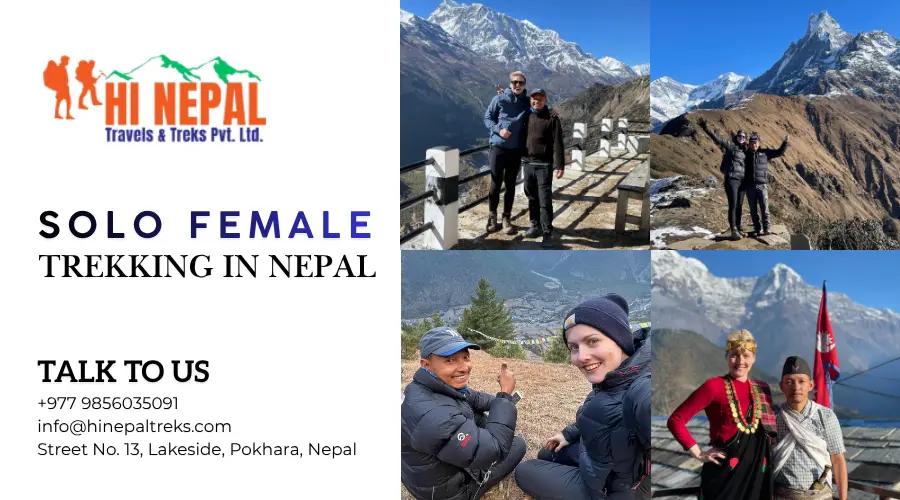
Yes, women can trek solo in Nepal. But solo trekking does not mean every route is equally suitable for independent travel.
A short and busy trek such as Ghorepani Poon Hill is very different from a high-altitude route such as the Everest Base Camp Trek or a restricted route such as the Manaslu Circuit Trek.
Your experience, the route, altitude, season, current trekking regulations, and how comfortable you are handling unexpected situations all matter.
So the better question is not simply, “Is Nepal safe for solo female trekkers?”
It is: “Which trek is right for me, and how independently should I do it?”
Can You Trek Alone in Nepal as a Woman?

You can travel to Nepal alone and join a trek, travel with a guide, or, where regulations allow, trek independently.
These are three different things.
Solo travel means you are travelling through Nepal by yourself.
Solo trekking with a guide means you are the only client in your trekking group, but a guide accompanies you.
Independent trekking means you manage the route, accommodation, navigation, permits, and problems yourself.
For a first-time visitor, the second option can be a useful middle ground. You still have the freedom of travelling alone without having to deal with every trekking decision by yourself.
The rules also vary between trekking regions. Routes such as Manaslu and Upper Mustang have different permit and guide requirements from less restricted trekking areas, so do not assume that a rule that applies to one trek automatically applies to another.
Which Nepal Treks Are Suitable for Solo Female Travelers?
The route you choose can make a bigger difference to your experience than whether you are travelling alone.
| Trek | Suitable for a first solo trek? | What to consider |
|---|---|---|
| Poon Hill | Yes | Shorter route with regular accommodation and plenty of trekkers |
| Mardi Himal | Yes, with preparation | Steeper sections and higher altitude than Poon Hill |
| Langtang Valley | Yes, with preparation | More remote than the busiest Annapurna routes |
| Annapurna Base Camp | Yes, with preparation | Longer days and increasing altitude |
| Annapurna Circuit | Better with trekking experience | Long route, high altitude and Thorong La |
| Everest Base Camp | Better with preparation | Altitude is the main concern |
| Manaslu Circuit | Not ideal for independent beginners | Restricted area and more remote sections |
| Upper Mustang | Not ideal for independent beginners | Restricted-area regulations and additional logistics |
For a first solo trek, Poon Hill is one of the easier places to start. You can also consider Mardi Himal or Annapurna Base Camp if you are physically prepared and understand the demands of trekking at altitude.
Remote and restricted routes are a different proposition. The challenge is not simply navigation. You also have to deal with permits, accommodation, weather, transportation, altitude and fewer services along parts of the route.
What Are the Main Safety Concerns?
Nepal is generally welcoming to female travelers, but trekking has risks that have little to do with gender.
Altitude
Altitude is one of the biggest concerns on high Himalayan treks.
You can be fit, experienced, and completely healthy and still develop altitude sickness. This is why a sensible itinerary matters more than trying to walk as quickly as possible.
If you develop symptoms such as headache, nausea, unusual fatigue, dizziness or difficulty sleeping after gaining altitude, do not simply push through them.
On high-altitude routes, your guide or trekking team should be prepared to recognize altitude-related problems and decide when you need to stop ascending or descend.
Our high-altitude trekking preparation guide covers the basics before you start a high-altitude trek.
Weather and trail conditions
Mountain weather can change quickly.
Rain can make lower trails slippery and increase the possibility of landslides or difficult river crossings. At higher elevations, snow, wind and poor visibility can become more important.
This is one reason a flexible itinerary is valuable. A fixed schedule should not be more important than trail conditions.
Getting lost or taking the wrong trail
Popular routes are generally easier to follow than remote trails, but that does not mean you should rely entirely on your phone.
Download maps before leaving, keep your phone charged, and know the name of your destination each day.
If you are unsure about a junction, ask a local guide, lodge owner or other trekkers rather than taking an unmarked shortcut.
Accommodation and personal belongings
Teahouses are a normal part of trekking in Nepal, but standards vary between routes and individual lodges.
Keep your passport, permits, money, phone and other important belongings with you rather than putting them in luggage carried separately.
You do not need to treat every person you meet as a potential threat. Basic awareness is enough. If someone makes you uncomfortable, create distance and seek help from your guide, lodge staff or other trekkers.
What About Trekking Alone During the Off-Season?
Season matters.
Spring and autumn are generally the busiest trekking periods, which means more people are on the major trails and weather conditions are often more suitable for trekking.
Winter can work well for lower-altitude routes, while high passes and high-altitude trails require more preparation because of cold and snow.
Monsoon brings rain, muddy trails, leeches and possible landslides to many trekking areas. Some rain-shadow regions, including Upper Mustang, are a different case, but they also have their own regulations and logistical considerations.
If this is your first solo trek, choosing a season with more predictable trail conditions can make the experience considerably easier.
What Should You Do Before Your Trek?

You do not need to overprepare, but you should know what you are getting into.
Before leaving Kathmandu or Pokhara:
- Check the current permit and guide requirements for your specific route.
- Share your itinerary with someone you trust.
- Get travel insurance that covers the activities and altitude of your trek.
- Save important emergency contacts.
- Download an offline map.
- Carry enough cash for the route.
- Break in your trekking footwear before the trip.
- Pack waterproof layers if you are travelling during the wet season.
- Carry a warm layer even if the weather is warm in Kathmandu or Pokhara.
- Tell someone if you change your route or expected arrival point.
For higher-altitude treks, your preparation should also include understanding altitude sickness rather than relying on fitness alone.
What Should a Solo Female Trekker Pack?
Your exact packing list depends on the route and season, but the basics remain fairly simple.
Clothing: quick-drying base layers, trekking trousers, warm layers, waterproof jacket and rain trousers.
Footwear: broken-in trekking shoes or boots with good grip, plus lightweight footwear for evenings.
Trekking gear: trekking poles, headlamp, daypack, water bottle and a waterproof cover or dry bags.
Health and personal items: basic first aid supplies, blister treatment, personal medication, sunscreen, sunglasses and personal hygiene products.
Documents: passport, permits, insurance details and emergency contacts.
For a detailed route-specific list, it is better to prepare according to the trek rather than carrying a huge generic packing list.
Should You Hire a Guide?
This depends on the route, your experience and the current regulations.
A guide is particularly useful when you are:
- trekking at high altitude for the first time
- travelling on a remote route
- unsure about navigation
- uncomfortable making decisions during bad weather
- trekking on a route with guide requirements
- travelling alone but still wanting someone locally experienced with you
A guide also changes the experience in ways that have nothing to do with safety. They can help communicate with teahouses, explain local customs, adjust the itinerary when conditions change and help you deal with unexpected problems.
For someone who wants to travel alone but does not necessarily want to manage the entire trek alone, a private guided trek can be a good compromise.
Solo Female Trekking With Hi Nepal
If you want the independence of travelling on your own but would rather not manage every trekking detail yourself, Hi Nepal Travels & Treks can arrange a guided trek around your route, dates and preferences.
The useful part is not simply having someone walk beside you. A local trekking team can handle practical details such as permits, accommodation, transportation and route planning while you concentrate on the trek itself.
For solo female travelers, Hi Nepal can also arrange a female guide when available and requested.
The right approach depends on the trek. A short popular route and a remote high-altitude trek should not be treated as the same trip simply because both are called “solo trekking.”
You can explore Hi Nepal’s trekking routes or contact the team if you already know which trek you want to take.
So, Is Solo Female Trekking in Nepal Safe?

Yes, but do not treat “safe” as a blanket label for every trekking route.
For many women, solo trekking in Nepal is a realistic and rewarding way to travel. The important part is choosing a route that matches your experience and understanding what you are responsible for once you leave the city.
If you are new to trekking, starting with a shorter and more established route such as Poon Hill can make more sense than immediately choosing a remote high-altitude circuit.
If you already have trekking experience, you have more options, but altitude, weather, regulations and trail conditions still need to be taken seriously.
The goal is not to remove every uncertainty from the trek. It is to know which uncertainties you can handle yourself and where having local support makes sense.
Frequently Asked Questions
Is Nepal safe for solo female travelers?
Nepal is a popular destination for solo travelers, including women. However, normal travel awareness still matters, and trekking safety depends heavily on the route, weather, altitude and your preparation.
What is the best trek in Nepal for a first-time solo female trekker?
Poon Hill is one of the more approachable choices because it is relatively short and has regular accommodation along the route. Mardi Himal and Annapurna Base Camp can also work for travelers who are prepared for longer and higher trekking days.
Can a woman trek alone to Everest Base Camp?
It depends on the current trekking regulations and your experience. EBC is a high-altitude trek, so the bigger consideration is often whether you are prepared for the altitude, length and changing mountain conditions rather than simply whether you are travelling alone.
Is Manaslu suitable for solo female trekking?
Manaslu is a more demanding choice because it is a restricted trekking region with additional regulations and remote sections. It should not be approached in the same way as a short, popular trek such as Poon Hill.
Should I hire a female trekking guide?
You do not necessarily need a female guide, but some solo female travelers prefer one because they feel more comfortable discussing personal, cultural or practical concerns with another woman. Availability depends on the dates and route.