
VAT NO. 604389161
Manaslu Circuit Trek vs Annapurna Circuit Trek : Detailed Comparison

Manaslu Circuit vs Annapurna Circuit Trek: Which Himalayan Adventure is Right for You?

Hi Nepal Team

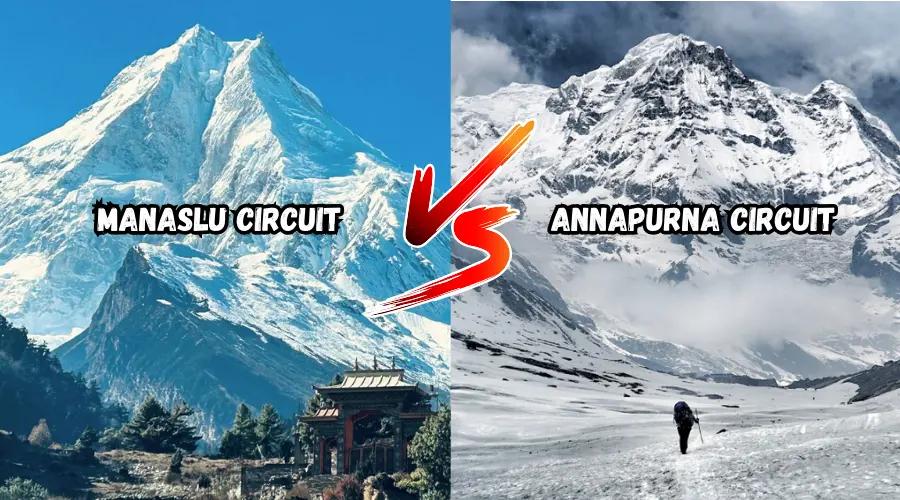
Nepal remains the gold standard for high-altitude trekking, and in 2026 its Himalayan trails are more diverse and rewarding than ever. From lush lower valleys filled with blooming rhododendron forests to the stark, wind-sculpted terrain of high mountain passes, trekking in Nepal is not just an adventure; it’s a transformative experience. Among the country’s many iconic routes, two classic circuit treks continue to dominate every serious trekker’s shortlist: the Manaslu Circuit vs Annapurna Circuit Trek.

These two legendary treks are frequently compared because they share a strikingly similar foundation. Both journeys circle a colossal 8,000 meter Himalayan giant, Annapurna I and Mount Manaslu and both culminate in an exhilarating crossing of a high-altitude pass above 5,000 meters. Along the way, trekkers experience dramatic shifts in scenery, from subtropical forests and traditional villages to alpine tundra and high Himalayan desert. The Manaslu Circuit Trek is often described as “the Annapurna Circuit of twenty years ago,” offering the same sense of raw wilderness and deep cultural immersion, but with fewer crowds and minimal road influence.

This comparison guide is designed to help you decide which trek best suits your travel style and experience level. Whether you are a first-time trekker drawn to the well-developed infrastructure and social teahouse culture of the Annapurna Circuit, an experienced hiker seeking a more challenging and restricted adventure on the Manaslu Circuit, or an explorer searching for solitude and Tibetan-influenced borderland culture, understanding the key differences between these two routes is the first step toward planning your ideal Himalayan trek.

Overview of the Two Circuits

Choosing between the Manaslu Circuit Trek and the Annapurna Circuit Trek comes down to understanding not just distances and elevations, but the character of each journey. Below is a clear snapshot of how these two iconic Himalayan circuits compare in 2026, from terrain and altitude to atmosphere and trekking style.

1. Manaslu Circuit Trek – Quick Snapshot

Birendra Lake, high up at Manaslu Region: Manaslu Circuit Trek
Img Src: Himalayan Master

Often referred to as the “Secret Annapurna,” the Manaslu Circuit Trek is ideal for adventurers seeking a raw, old-school Himalayan experience. This route feels like stepping back in time, offering remote trails, deep cultural immersion, and a sense of exploration that is increasingly rare in Nepal’s more popular regions.

A. Location and region

The Manaslu Circuit lies in the Gorkha District of western Nepal, circling Mount Manaslu (8,163 m), the world’s eighth-highest peak. Running close to the Tibetan border, the trail passes through traditional Buddhist villages, ancient monasteries, and high mountain landscapes shaped by centuries of isolation.

B. Total distance & duration

The full circuit covers roughly 177–180 kilometers, typically completed in 14 to 18 days. Acclimatization days, especially in villages like Samagaun, are essential for a safe and enjoyable trek.

1C. Highest point (Larkya La Pass)

Larkya La Pass (5,106 m) is the defining challenge of the trek. Known for its long ascent, exposed terrain, and strong winds, the crossing delivers a true high-altitude adventure without the need for technical climbing skills.

D. Trekking style (restricted, remote)

The Manaslu Circuit is classified as a Restricted Area Trek, meaning solo trekking is not permitted. A licensed guide and a minimum of two trekkers are required. Teahouses exist throughout the route, but they are simple and traditional, adding to the authentic wilderness experience.

Explore our detailed Manaslu Circuit Trek Itinerary Package with a day-by-day schedule – your adventure starts here!

2. Annapurna Circuit Trek – Quick Snapshot

Beautiful view of Annapurna Conservation Area

The Annapurna Circuit Trek is a timeless Himalayan classic. While road construction has altered some lower sections, the trek remains one of the most varied, scenic, and socially engaging routes in Nepal, especially popular with first-time high-altitude trekkers.

A. Location and Region

Set within the Annapurna Conservation Area of central Nepal, the trail winds through the districts of Lamjung, Manang, Mustang, and Myagdi. Trekkers experience an extraordinary cultural transition, from lush Hindu farming villages to the arid, Tibetan-influenced landscapes of the high Himalayas.

B. Total Distance & Duration

Originally stretching over 230 km, the modern Annapurna Circuit is more flexible due to road access. Most trekkers now walk 160–190 km over 12 to 21 days, often extending the journey with side trips such as Tilicho Lake.

C. Highest Point (Thorong La Pass)

Thorong La Pass (5,416 m) is one of the highest trekking passes in the world and the highlight of the circuit. The crossing between the Manang and Mustang valleys is both physically demanding and visually dramatic.

D. Trekking Style (classic, well-developed)

Known as the famous “Apple Pie Trail,” the Annapurna Circuit offers comfortable teahouses, varied food menus, Wi-Fi access, and hot showers in many villages. It’s highly social and accessible. As of 2023/2024, Nepal requires foreign trekkers to be accompanied by a licensed guide on this route for safety and regulation compliance.

Explore our detailed Annapurna Circuit Trek Itinerary Package with a day-by-day schedule – your adventure starts here!

Manaslu Circuit vs Annapurna Circuit Trek: Quick Comparison Table

Manaslu Circuit vs Annapurna Circuit Trek – Quick Comparison
Feature Manaslu Circuit Trek Annapurna Circuit Trek
Duration 14–18 days 10–18 days (flexible)
Difficulty Moderate to Challenging Moderate
Cost Higher due to restricted permits and mandatory guide Lower to moderate
Crowd Level Very low High during peak seasons
Cultural Experience Strong Tibetan-influenced culture Mixed Hindu and Buddhist traditions
Scenic Diversity Remote valleys, glaciers, dramatic mountain views Diverse landscapes, villages, and high passes
Infrastructure Basic teahouses and limited facilities Well-developed lodges and services
Permit Requirement Restricted area permit + guide required Standard trekking permits
Road Impact Minimal road access Some sections affected by roads
Best Seasons March–May, September–November March–May, September–November (possible year-round)
Best For Adventure seekers and solitude lovers First-time trekkers and comfort seekers

Trekking Routes & Landscapes

For many trekkers, choosing between the Manaslu Circuit Trek and the Annapurna Circuit Trek ultimately comes down to the feel of the trail. While both trekking routes deliver unforgettable Himalayan scenery, the way you move through the landscape and how connected you feel to it differs dramatically.

Manaslu Circuit vs Annapurna Circuit Trek in Nepal

1. Manaslu Circuit Scenery: The Untamed Trail

The Manaslu Circuit Trek is often described as raw and untouched and that’s exactly its appeal. This route feels less like a commercial trekking corridor and more like a passage through a living Himalayan heritage, where culture and landscape remain closely intertwined.

A. Remote Villages and Untouched Trails

Manaslu winds through traditional villages such as Lho, Samagaun, and Samdo, where Tibetan-style stone homes, ancient monasteries, and long mani walls line the path. The trails are narrow and rugged, frequently carved into cliff edges. Here, it’s common to walk alongside yak caravans rather than vehicles, reinforcing the sense of isolation and authenticity.

B. Budhi Gandaki River Gorge

During the first half of the trek, the route follows the dramatic Budhi Gandaki River gorge. High suspension bridges span roaring rapids, while dense forests of rhododendron and pine gradually thin out as the trail climbs toward the high Himalayas. This steady transition makes the journey feel immersive and wild.

C. Himalayan Views (Manaslu, Himlung, Ganesh Himal)

Scenery on the Manaslu Circuit is close, towering, and intensely vertical. Trekkers are rewarded with awe-inspiring views of Mount Manaslu (8,163 m), the sharp ridgelines of Himlung Himal, and the massive Ganesh Himal range. The sheer proximity of these peaks creates a powerful, almost overwhelming mountain experience.

2. Annapurna Circuit Scenery: A Journey Through Diversity

The Annapurna Circuit Trek is world-renowned for its extraordinary range of landscapes. Few treks on Earth offer such a dramatic and continuous ecological transition in a single journey.

A. From Subtropical Valleys to Alpine Desert

The trek begins in warm, green lowlands dotted with terraced rice fields and traditional farming villages. As you ascend, the scenery shifts through temperate forests, alpine pine and juniper zones, and eventually into the Manang region, a stark, high-altitude rain-shadow area that closely resembles the Tibetan Plateau.

B. Kali Gandaki Valley

After crossing Thorong La Pass, the trail descends into the legendary Kali Gandaki Valley, recognized as the deepest gorge in the world. This wind-swept landscape is home to the charming village of Marpha, famous for its apple orchards, and the fossil-rich riverbanks where trekkers can spot Shaligrams, ancient ammonite fossils.

C. Himalayan views (Annapurna, Dhaulagiri, Machhapuchhre)

The Annapurna Circuit offers broad, sweeping panoramas rather than close-up drama. Along the way, trekkers enjoy uninterrupted views of the Annapurna Massif (Annapurna I–IV), the massive white face of Dhaulagiri (8,167 m), and the unmistakable fishtail silhouette of Machhapuchhre (6,993 m).

Check out our detailed blog on Best Trekking Routes in Nepal and plan your next trek.

Check out our detailed blog on Best Trekking Routes in Nepal and plan your next trek.

Cultural Experience & Local Life

Nepal's culture and local life of peoples

While the Himalayan peaks dominate the skyline, it’s the people, traditions, and daily rhythms of mountain life that truly define each trek. In 2026, the cultural contrast between the Manaslu Circuit Trek and the Annapurna Circuit Trek remains one of the strongest deciding factors for trekkers choosing between these two legendary trekking routes.

1. Manaslu Circuit Culture: A Living Tibetan Heritage

The Manaslu region remained closed to foreign travelers until the early 1990s and is still classified as a restricted area today. This long isolation has helped preserve a way of life that feels deeply rooted in Tibetan traditions and remarkably untouched by mass tourism.

A. Tibetan-Influenced Mountain Communities

The upper Manaslu region is home to the Nubri and Tsum people, descendants of Tibetan settlers who migrated across the high Himalayan passes centuries ago. In villages such as Lho and Samdo, trekkers encounter locals wearing traditional chubas (woolen robes) and hear languages and dialects more closely aligned with Tibetan than modern Nepali.

B. Sacred Buddhist Landmarks

The Manaslu Circuit unfolds like an open-air Buddhist sanctuary. The trail is lined with extensive mani walls carved with the mantra Om Mani Padme Hum, countless spinning prayer wheels, and streams of colorful prayer flags carried by the wind. Important monasteries, most notably Ribung Gompa in Lho, offer rare opportunities to observe monastic life framed by soaring Himalayan peaks.

C. Minimal Tourism, Meaningful Encounters

Strict permit regulations limit visitor numbers, ensuring tourism remains low-impact. As a result, interactions with locals feel personal and sincere. Trekkers are welcomed as guests rather than customers, gaining insight into a traditional lifestyle still centered on yak herding, barley farming, and seasonal mountain rhythms.

2. Annapurna Circuit Culture: A Tapestry of Himalayan Life

The ACT showcases Nepal’s remarkable ethnic diversity. As the trail climbs from subtropical valleys to high alpine deserts and descends again, trekkers pass through a succession of distinct cultural landscapes.

A. Blend of Ethnic Communities

The journey begins among the Gurung communities of the southern foothills, renowned for their history in the British Gurkha regiments. Higher up, the trail enters Manangi territory, where life revolves around trade and survival in a harsh, high-altitude environment. Descending into the Kali Gandaki Valley, trekkers encounter the Thakali people, famous across Nepal for their hospitality and exceptional Dal Bhat cuisine.

B. Birthplace of Teahouse Trekking

The Annapurna Circuit is widely regarded as the home of Nepal’s iconic teahouse trekking culture. These family-run lodges are more than places to sleep, they serve as social gathering points where trekkers and locals connect over shared meals and stories, often around a warm, central stove.

C. Deeper Cultural Access.

Thanks to better accessibility, the Annapurna region offers frequent opportunities to engage with spiritual and cultural landmarks. A highlight is the sacred Muktinath Temple, revered by both Hindus and Buddhists. Here, trekkers witness pilgrims, monks, and wandering sadhus performing rituals at the famous 108 water spouts, creating a powerful and unforgettable cultural experience.

Difficulty Level & Physical Challenge

Beautiful view of Mountain range in the back with buddhist flag

Although both the Manaslu Circuit Trek and the Annapurna Circuit Trek fall into the “challenging” category, the type of difficulty each presents is very different. In 2026, the decision often comes down to what kind of challenge you’re looking for: endurance and isolation, or altitude and vertical gain.

1. Manaslu Circuit Difficulty: A True Wilderness Endurance Test

The Manaslu Circuit is generally regarded as the more demanding trek, not because it climbs higher, but because of its rugged terrain and remote setting.

A. Trail Conditions

The route is raw and minimally developed. Trekkers navigate narrow footpaths etched into steep mountainsides, rocky glacial moraines, and countless high suspension bridges swaying above deep gorges. Lower sections can be muddy and slick, especially after rain, while the upper elevations often involve loose scree, icy sections, or snow-covered trails depending on the season.

B. Altitude & Physical Demands

Although Larkya La Pass (5,106 m) is lower than Thorong La, the crossing day is longer and more exhausting. The trek from Dharamsala to Bimthang typically takes 8 to 12 hours, combining a steady, energy-draining ascent with a prolonged descent that can be punishing on tired legs and knees.

C. Remoteness Factor

Isolation is the defining challenge of the Manaslu Circuit Trek. Teahouses are fewer and basic, medical facilities are extremely limited, and evacuation logistics can be slow in an emergency. Trekkers must be mentally prepared for limited connectivity, fewer comforts, and a genuine wilderness experience far from modern conveniences.

2. Annapurna Circuit Difficulty: The Ultimate Altitude Challenge

The Annapurna Circuit is more accessible and supported by established infrastructure, but it presents one of the most serious altitude challenges on any classic trek in Nepal.

A. Trail accessibility

Paths on the Annapurna Circuit are generally wide, clearly marked, and well maintained. Frequent villages and teahouses allow trekkers to adjust daily distances, making the route flexible and forgiving for those who manage their pace wisely.

B. Impact of Road Access

Road construction now reaches much of the lower valley. While this improves evacuation options and safety, trekking on dusty Jeep roads can be physically tiring and less scenic. In 2026, most experienced trekkers opt for the NATT (Natural Annapurna Trekking Trails), which avoid roads but include additional uphill and downhill sections.

C. Thorong La Pass (5,416 m)

Thorong La is the highest point reached on a standard trekking route in Nepal. Even with a clear, established trail, the extreme altitude makes the crossing a serious test. The final ascent from High Camp is steep and breathless, where the risk of Acute Mountain Sickness (AMS) is highest. The reward, however, is a relatively quick and straightforward descent into Muktinath, far less punishing than the long drop from Larkya La.

Permits & Regulations

Beautiful scene of landscape in Manaslu region - on the way to birendra lake

Handling permits for trekking in Nepal can feel almost as demanding as the trek itself. In 2026, the Manaslu Circuit Trek and the Annapurna Circuit Trek follow very different regulatory frameworks, especially when it comes to how independently you’re allowed to travel.

1. Manaslu Circuit Permits: Trekking in a Restricted Region

Because the Manaslu Circuit runs close to the Tibetan border, it is officially designated as a Restricted Area Trek. As a result, entry is closely regulated by the Nepalese government.

A. Restricted Area Permit (RAP)

This is the most important and costly permit for Manaslu. Prices vary by season:

  • Autumn (September–November): USD 100 for the first 7 days, plus USD 15 for each additional day
  • Spring, Winter & Summer (December–August): USD 75 for the first 7 days, plus USD 10 per additional day

B. Conservation Area Permits (MCAP & ACAP)

Since the route passes through both the Manaslu Conservation Area and the Annapurna Conservation Area, trekkers must obtain two additional permits.

  • MCAP: NPR 3,000
  • ACAP: NPR 3,000

(Approximately USD 23 each)

C. Minimum Group Requirement

Solo trekking is not permitted in Manaslu. A minimum of two foreign trekkers is required to issue the Restricted Area Permit. If you’re traveling alone, most trekking agencies arrange permit pairing, often referred to informally as a “grouped” or “paired” permit.

D. Licensed Guide Requirement

A government-licensed guide is mandatory for the Manaslu Circuit Trek. All permits must be processed through a registered Nepalese trekking agency, making independent trekking legally impossible in this region.

2. Annapurna Circuit Permits: A More Accessible Classic

The Annapurna Circuit Trek has a simpler permit process, although regulations around guides have become stricter in recent years.

A. Annapurna Conservation Area Permit (ACAP)

This is the main ACAP permit required for the entire Annapurna Circuit.

  • Cost: NPR 3,000 (approx. USD 23)
  • Valid for one-time entry into the conservation area

B. TIMS Card Update

The TIMS (Trekkers’ Information Management System) card, once standard for trekking in Nepal, has largely been phased out for major routes like Annapurna. In most cases, trekkers now only need the ACAP along with their registered guide’s documentation.

C. Guide Requirement (Important 2026 Update)

While older travel guides may still list Annapurna as a route where guides are optional, regulations have changed. The Nepal Tourism Board now requires all foreign trekkers to be accompanied by a licensed guide in national parks and conservation areas, including the Annapurna region.

This rule was introduced to improve trekker safety and support local employment. Although Annapurna offers more flexibility in route planning than Manaslu, solo trekking without a guide is no longer legally permitted in 2026.

Accommodation & Food

Accommodation facilities in Manaslu Circuit Trek Route

By 2026, the comfort gap between the Manaslu Circuit Trek and the Annapurna Circuit Trek has narrowed considerably. However, the overall atmosphere of staying and dining along these routes remains very different. One offers a refined, well-established trekking infrastructure, while the other still delivers the warmth and simplicity of a traditional mountain lifestyle.

1 Manaslu Circuit Accommodation & Food: A Remote Yet Evolving Experience

Teahouses along the Manaslu Circuit have steadily improved in recent years. While luxury lodges are still rare, many villages now offer far more comfort than trekkers once expected from this remote Himalayan route.

A. Teahouse Experience

Accommodation is primarily in family-run lodges constructed from stone and timber. In villages such as Namrung, Lho, and Samagaon, trekkers can find clean, comfortable rooms, occasionally with attached bathrooms and solar-powered charging facilities. As the trail climbs higher, particularly around Dharamsala (Larkya Phedi), facilities become more basic, with shared squat toilets, thin walls, and communal dining rooms that double as the main source of warmth.

B. Food on the Manaslu Circuit

Meals are largely locally sourced and organic, reflecting the region’s traditional way of life. Dal Bhat remains the staple, but larger settlements now offer a limited range of international trekking dishes, including pizza, pasta, and apple pie. While satisfying, the menu options are simpler and less varied compared to Annapurna.

C. Seasonal Limitations

Due to its isolation, the Manaslu Circuit is highly seasonal. High-altitude teahouses, especially in Dharamsala, may close during winter (late December to February) or peak monsoon months. Planning your trek around the right season is essential.

2. Annapurna Circuit Accommodation & Food: The Gold Standard of Teahouse Trekking

The Annapurna Circuit has long set the benchmark for teahouse trekking in Nepal. Its mature infrastructure has earned it a reputation as one of the most comfortable long-distance treks in the Himalayas.

A. Well-Developed Lodging

In popular towns such as Chame, Manang, and Marpha, many lodges resemble small mountain hotels rather than simple teahouses. Facilities often include heated dining halls, electric blankets, private bathrooms, and reliable Wi-Fi, making it easy to stay connected even at altitude.

B. A Food Lover’s Trail

The Annapurna Circuit is famous for its diverse menus. In places like Manang, trekkers can enjoy fresh bakery items, espresso coffee, yak burgers, and international meals. Road access in the lower valleys allows teahouses to stock imported goods, fresh produce, and even occasional craft beers.

C. Modern Comforts

Hot gas-powered showers are widely available across the route. While they usually come at an extra cost, the convenience of a dependable hot shower after a long trekking day is a major attraction for many travelers.

Cost Comparison

Tea House Accommodation in Annapurna Circuit Route

In 2026, the price difference between the Manaslu Circuit Trek and the Annapurna Circuit Trek looks a little different than it did in the past. Manaslu still sits at the higher end due to its restricted-area status and fixed logistics, while the Annapurna Circuit now has a slightly higher entry cost than before because a licensed guide is mandatory.

1. Manaslu Circuit Trek Cost: Paying for Remoteness & Exclusivity

The Manaslu Circuit is a carefully regulated trek, and that exclusivity comes at a premium. All permits must be arranged through a registered trekking agency, and independent planning is not permitted.

A. Permit Costs (2026)

I. Restricted Area Permit (RAP):

  • USD 100 for the first 7 days (September–November)
  • USD 75 for the first 7 days (December–August)
  • Additional days: USD 15 (autumn) or USD 10 (other seasons)

II. Conservation Area Permits:

  • MCAP: NPR 3,000 (approx. USD 23)
  • ACAP: NPR 3,000 (approx. USD 23)

III. Local Municipality Fee: 

  • Chumnubri Rural Municipality Fee: NPR 1,000 (approx. USD 8), collected at the trail entry point

B. Guide & Porter Expenses

I. Licensed Trekking Guide (Mandatory):

  • Expect to pay USD 30–45 per day, which includes the guide’s wages, insurance, meals, and accommodation.

II. Porter (Optional):

  • Typically USD 20–30 per day. One porter usually carries 20–25 kg, often shared between two trekkers.

C. Overall Budget Estimate

For a standard 14-day Manaslu Circuit Trek, most trekkers should plan on spending USD 1,100 to USD 1,600. This generally covers all permits, guide services, porter (if used), shared Jeep transport, and basic teahouse accommodation and meals.

2. Annapurna Circuit Trek Cost: Maximum Flexibility

The Annapurna Circuit Trek offers a wide price range, making it one of the most flexible trekking experiences in Nepal. Trekkers can keep costs low or upgrade to premium comfort, depending on their travel style.

A. Permit Fees

I. Annapurna Conservation Area Permit (ACAP): NPR 3,000 (approx. USD 23)

II. TIMS / Trekker Tracking Fee:

  • While requirements vary slightly by region in 2026, most trekkers should budget around NPR 2,000 (USD 20) for registration and tracking.

B. Transportation Choices

  • Public Bus to Besisahar: USD 10–15 (budget-friendly option)
  • Private 4WD Jeep: USD 150–250 (faster and more comfortable)

C. Guide Cost (Mandatory for 2026)

  • Although Annapurna is not a restricted area, regulations still require a licensed guide. Guide fees generally range from USD 25 to 35 per day.

D. Budget vs. Luxury Trekking Options

I. Budget Trek (USD 800–1,000):

  • Public transportation, standard teahouse rooms, and simple local meals such as Dal Bhat.

II. Luxury Trek (USD 2,500–4,000+):

  • Premium “comfort lodges,” heated blankets, private Jeep transfers, upgraded meals, and optional helicopter return from Jomsom to Pokhara, bypassing the dusty road sections.

Best Time to Trek: Manaslu Circuit vs Annapurna Circuit Trek

When it comes to trekking in Nepal, timing can make or break the experience. While both the Manaslu Circuit Trek and the Annapurna Circuit Trek are best tackled in spring and autumn, conditions on the trail feel very different on the remote Manaslu route compared to the more established Annapurna Circuit.

1. Best Season for the Manaslu Circuit Trek

Beautiful season to trek to Manaslu circuit

The Manaslu Circuit is highly dependent on weather conditions due to the exposed Larkya La Pass (5,106 m), which is vulnerable to snowfall and strong winds.

A. Spring Season (March–May)

Seasonal Highlights:

  • Rhododendron Bloom: Lower elevations burst into color with red, pink, and white rhododendron forests in full bloom.
  • Peaceful Trails: While Annapurna becomes increasingly busy, Manaslu remains quiet, offering a calm, almost meditative trekking atmosphere.
  • Wildlife Sightings: Spring improves chances of spotting Himalayan tahr and blue sheep as they move through lower grazing areas.

Potential Challenges:

  • Late Winter Snow: In early March, snow can still block Larkya La, sometimes requiring micro-spikes or route changes if conditions are unsafe.

B. Autumn Season (September–November)

Seasonal Highlights:

  • Crystal-Clear Views: Post-monsoon skies deliver sharp visibility, making autumn the prime season for photography with uninterrupted views of Mount Manaslu (8,163 m).
  • Harvest Season: Upper villages like Samagaun come alive with golden fields of barley and buckwheat, adding cultural richness to the trek.

Weather Considerations:

  • Strong Winds: Afternoon winds around Larkya La can be intense, which is why most crossings begin between 3:00 and 4:00 AM to ensure safer conditions.

Read our detailed blog on the best season for the Manaslu Circuit Trek, with season-by-season tips!

2. Best Season for the Annapurna Circuit Trek

Best seasons to trek annapurna circuit with the best and clear view

The Annapurna Circuit is generally more forgiving thanks to well-developed infrastructure, but the high-altitude Thorong La Pass (5,416 m) still dictates the safest trekking windows.

A. Seasonal Advantages

  • Autumn Festivals (2026): Trekking in October allows travelers to witness major Nepalese festivals such as Dashain (Oct 11–21) and Tihar (Nov 7–11). Teahouses offer festive meals and decorations, though transportation may be busier and harder to book.
  • Spring Temperatures: Lower sections between Besisahar and Chame can be warm in May, but the cooler alpine air at higher elevations offers welcome relief.

B. Balancing Crowds and Conditions

  • Peak Season (October–November): Expect the most stable weather and clear skies, but also the highest number of trekkers. Advance bookings are essential, as rooms can fill quickly and overflow sleeping in dining halls is common.
  • Shoulder Season (Early September / Late May): A bit more unpredictable weather, but far fewer trekkers. Those willing to accept occasional rain or heat are often rewarded with quieter trails and spectacular pass-day views.

Read our detailed blog on the the best time to trek the Annapurna Circuit, with season-by-season insights!

Crowd Level & Trekking Experience

For many trekkers in 2026, the choice between the Manaslu Circuit Trek and the Annapurna Circuit Trek comes down to a simple but important question: Do you want solitude or social energy? Both routes offer breathtaking Himalayan scenery, but the atmosphere on the trail could not be more different.

1. Manaslu Circuit Trek: Quiet Trails & True Wilderness

Often described as the “Annapurna Circuit of the past,” the Manaslu Circuit still delivers the sense of isolation and raw adventure that has largely disappeared from Nepal’s more popular trekking routes.

A. Trail Atmosphere

Manaslu feels like a journey into Nepal’s untamed backcountry. Long sections of the trail pass in near silence, broken only by the sound of the Budhi Gandaki River, wind through the forests, or your own footsteps on the path.

B. Crowd Levels

Low to moderate. Entry restrictions, mandatory guides, and limited permits naturally control the number of trekkers. Even during peak months like October, the trail never feels crowded, and bottlenecks at villages or passes are rare.

C. Daily Encounters

Most interactions are with local villagers, yak or mule caravans, and small, experienced trekking groups. Evenings are calm and communal, with just a few groups sharing stories around a single wood-burning stove in intimate dining rooms.

2. Annapurna Circuit Trek: The World’s Most Social Trek

The Annapurna Circuit is famous not just for its landscapes, but for its vibrant trekking community. If Manaslu is about solitude, Annapurna is about connection.

A. Trail Atmosphere

The energy is lively and international. Trekkers from all over the world cross paths daily, and it’s common to form “trail families” that walk together for days or even the entire circuit before celebrating at the finish.

B. Crowd Levels

High, especially in spring and autumn. During peak season, the route can feel like a continuous stream of hikers. Popular hubs such as Manang and Muktinath are buzzing with activity, featuring bakeries, cafés, movie nights, and packed teahouses.

C. Impact of Infrastructure

Road construction in the lower sections means you’ll occasionally share the trail with Jeeps and motorbikes, which can reduce the wilderness feel. However, this same accessibility makes Annapurna one of the safest and most flexible long-distance treks in Nepal.

Safety & Accessibility

On the way to Jagat - Manaslu Circuit Trek

One of the clearest differences between the Manaslu Circuit Trek and the Annapurna Circuit Trek in 2026 is how easy it is to get help or leave the trail when things don’t go as planned. One route is supported by a strong safety network, while the other demands a higher level of self-reliance.

1. Rescue & Evacuation: How Safe Is Each Trek?

In the Himalayas, rescue speed depends heavily on infrastructure, nearby air access, and the number of people on the trail.

A. Annapurna Circuit Trek: Strong Safety Support

The Annapurna Circuit is widely considered one of the safest long-distance treks in Nepal due to its developed rescue system.

Medical Facilities: The Himalayan Rescue Association (HRA) runs a seasonal medical clinic in Manang, staffed by experienced international volunteer doctors who specialize in altitude-related illnesses.

Evacuation Speed: Because of constant trekking traffic, helicopters operate frequently in the region. In most emergencies, a helicopter can reach the trail within 1 to 3 hours, weather conditions permitting.

B. Manaslu Circuit Trek: Remote and Self-Reliant

The Manaslu Circuit is significantly more isolated, which affects both medical access and evacuation logistics.

Medical Support: There are no major international clinics along the route. Trekkers depend largely on their licensed guide’s first-aid training and small local health posts in villages.

Evacuation Process: All evacuations are handled by helicopter and must be arranged through your trekking agency in Kathmandu. Since Manaslu is a restricted area, additional paperwork is often required even during emergencies adding to response time.

2 Connectivity: Mobile Network & Internet Access

Staying connected on the trail can be useful for checking weather updates or staying in touch with family but coverage varies greatly between the two routes.

A. Annapurna Circuit Connectivity

Mobile Network: Both NTC and Ncell provide relatively strong 4G coverage in the lower sections. Signal is often available up to Manang, though it disappears completely around Thorong Phedi and Thorong La Pass.

Wi-Fi Access: Almost every teahouse offers Wi-Fi. In 2026, many lodges use Starlink or high-speed radio links, typically charging USD 3–5 for access.

B. Manaslu Circuit Connectivity

Mobile Network: NTC (Nepal Telecom) is the only reliable provider in the Manaslu region. Coverage generally lasts until Samagaon, after which trekkers enter a connectivity blackout for 2–3 days while crossing Larkya La.

Wi-Fi Access: Available in larger villages like Namrung and Samagaon, but speeds are slow and service can drop during bad weather. Expect a genuine digital detox for a significant portion of the trek.

3. Road Access & Exit Options: How Easy Is It to Leave the Trail?

The ability to shorten a trek or exit early due to fatigue, illness, or injury is a major factor when choosing between these two circuits.

A. Annapurna Circuit Trek: Multiple Exit Points

Road Access: Roads now extend to Manang on the eastern side and Jomsom/Muktinath on the western side.

Exit Flexibility: Trekkers are rarely more than a day’s walk from a road. You can easily catch a Jeep or local bus below 3,500 meters, making Annapurna a flexible trek with many bailout options.

B. Manaslu Circuit Trek: A Full Commitment

Road Access: Vehicle access ends at Soti Khola or Machha Khola at the start of the trek. The next road appears only at Dharapani, near the end of the circuit.

Exit Limitations: There are no mid-route road exits. Leaving early usually means backtracking for several days or arranging a helicopter evacuation. This makes the Manaslu Circuit a true commitment trek, best suited for confident and well-prepared hikers.

Environmental Impact & Sustainability

By 2026, the difference between the Annapurna Circuit Trek and the Manaslu Circuit Trek goes far beyond landscapes and mountain views; it’s also about how each trail handles the growing pressure of tourism. With Nepal welcoming record numbers of trekkers (over 246,000 visitors in the Annapurna region in 2025 alone), trekking has evolved from pure exploration into a shared responsibility for preservation.

1. Annapurna Circuit: Conservation Success Under Pressure

The Annapurna Conservation Area (ACA) is often praised as one of the world’s best examples of community-led conservation. However, its popularity in 2026 also brings visible environmental stress.

A. Waste & Plastic Management

The famous “Apple Pie Trail” generates an enormous amount of waste each season. Villages like Manang and Marpha now operate safe drinking water refill stations to cut down on plastic bottle usage. Even so, the sheer number of trekkers continues to overwhelm local waste collection and incineration systems.

B. Roads: Development vs. Degradation

Road expansion has been a double-edged sword. While it has improved access, healthcare, and income opportunities for local communities, it has also contributed to dust pollution and soil erosion. To counter this, the Nepal Alternative Trekking Trails (NATT) network has expanded in 2026, redirecting trekkers away from roads and helping preserve the traditional walking experience.

C. Energy Use in a High-Demand Region

With modern lodges offering hot showers, charging stations, and high-speed Wi-Fi, energy demand is higher than ever. Fortunately, many teahouses now rely on solar panels and micro-hydropower, reducing dependence on firewood and helping nearby forests remain surprisingly healthy despite heavy foot traffic.

2. Manaslu Circuit: A Model for Low-Impact Trekking

As a restricted trekking area, the Manaslu Circuit naturally limits visitor numbers, making it one of Nepal’s most environmentally intact high-altitude regions.

A. Wildlife & Biodiversity Protection:

The Manaslu Conservation Area Project (MCAP) places strong emphasis on wildlife preservation. In 2026, the use of camera traps and community-led patrols has played a key role in stabilizing populations of rare species such as the Snow Leopard and Red Panda.

B. Cultural Sustainability Matters:

Sustainability in Manaslu isn’t only ecological, it’s deeply cultural. In the Nubri and Tsum Valleys, local Buddhist traditions led by village Lamas strictly prohibit harming animals. This long-standing belief system has created a natural sanctuary where wildlife often appears more relaxed around humans.

C. A Smaller Footprint, Cleaner Trails:

With visitor numbers at less than 10% of Annapurna’s, Manaslu’s trails remain cleaner and quieter. Although waste systems are simpler, they are far less strained, resulting in a noticeably lower environmental impact.

3. Responsible Trekking in 2026: The Gold Standard

No matter which circuit you choose, responsible trekking is no longer optional; it’s expected. In 2026, conscious travelers follow these best practices:

A. Go Plastic-Free

Use water purification tools like LifeStraw, Grayl bottles, or chlorine tablets. Buying plastic bottles at high altitude is now widely frowned upon.

B. Pack Smart at Home

Remove excess plastic and cardboard packaging from snacks and gear before arriving in Nepal.

C. Respect Porter Welfare (25kg Rule)

Porter rights are closely monitored in 2026. Your personal bag should not exceed 12.5 kg, as porters usually carry two loads.

D. Walk Clockwise

Always pass Mani walls and stupas on the right (clockwise), a simple act that shows respect for Himalayan Buddhist culture and local spiritual beliefs.

Pros and Cons Summary: Manaslu Circuit vs Annapurna Circuit Trek

If you’re torn between the Manaslu Circuit Trek and the Annapurna Circuit Trek, this quick comparison should make the decision easier. By 2026, the real difference comes down to one simple question: Do you prefer comfort and community or isolation and authenticity?

1. Manaslu Circuit Trek – Advantages & Drawbacks

Why Choose Manaslu?

I. Untouched Himalayan Wilderness

Often referred to as “Annapurna from two decades ago,” Manaslu offers raw mountain landscapes without jeep roads or mass tourism. The scenery feels wild, dramatic, and refreshingly pure.

II. Rich Tibetan-Influenced Culture

Because the region borders Tibet and remains a restricted area, the Bhotia culture is exceptionally well preserved. Ancient monasteries, prayer walls, and traditional villages feel genuinely untouched by modern tourism.

III. True Solitude on the Trail

Crowds are minimal, even in peak season. You’ll enjoy peaceful days on the trail and cozy teahouse evenings shared with only a handful of fellow trekkers.

IV. Striking Vertical Landscapes

The trek’s geography is dramatic, starting in a deep river gorge and climbing steadily toward the spectacular Larkya La Pass, one of Nepal’s most impressive high-altitude crossings.

Things to Consider

I. Higher Overall Cost

The Restricted Area Permit (RAP) significantly increases the budget, and trekking with a licensed guide and a minimum group of two is mandatory.

II. Simpler Accommodation

Facilities are more basic compared to Annapurna. Expect fewer hot showers, limited food choices, and inconsistent internet connectivity.

III. Limited Exit Options

Manaslu is a commitment trek. Once you begin, there are no road shortcuts, leaving early usually means walking back or arranging a helicopter evacuation.

2 Annapurna Circuit Trek – Advantages & Drawbacks

Why Choose Annapurna?

I. Unmatched Landscape Variety

Few treks in the world offer such dramatic contrasts, from lush green valleys and waterfalls to the stark, desert-like terrain of Mustang.

II. World-Class Trekking Comfort

Known as the legendary “Apple Pie Trail,” Annapurna delivers top-tier infrastructure. Enjoy espresso coffee, bakeries, hot showers, Wi-Fi, and comfortable lodges, even at high altitude.

III. Vibrant Social Atmosphere

Annapurna is incredibly social. Towns like Manang are famous for their lively trekking scene, making it easy to form friendships and trail families.

IV. Highly Flexible Route

Road access and transport options allow you to shorten the trek if needed. Jeeps and flights from Jomsom make Annapurna ideal for trekkers with limited time or altitude concerns.

Things to Consider

I. Road Sections Break the Wilderness Feel

Some stretches of the original trail now run alongside jeep roads. While NATT (Alternative Trails) avoid most traffic, occasional vehicle noise is unavoidable.

II. Crowds in Peak Season

October and November can be extremely busy. Lodges fill quickly, and last-minute trekkers may end up sharing rooms or sleeping in dining halls.

III. Less Remote Experience

If you’re seeking a deep “off-the-grid” adventure, Annapurna may feel a bit too polished and well-traveled.

Which Trek Should You Choose in 2026?

There is no single “better” trek, only the one that fits your trekking style. With licensed guides now required on both routes in 2026, the real difference comes down to the experience you want at the end of each day: a lively, international trekking scene on the Annapurna Circuit or the quiet, spiritual isolation of the Manaslu Circuit.

Let’s break it down in the simplest way possible.

1. Based on Your Trekking Experience

A. Annapurna Circuit: Ideal for Fit First-Timers

If this is your first trek above 5,000 meters, the Annapurna Circuit is the safer and more forgiving option. The trail is wider, ascents are gradual, and the well-developed infrastructure acts as a built-in safety net.

If altitude starts to feel overwhelming, you’re never far from a road or jeep station. This flexibility makes Annapurna one of the best high-altitude treks in Nepal for beginners who are physically fit but new to extreme elevation.

B. Manaslu Circuit: Best for Experienced Trekkers

Manaslu is better suited for trekkers who already have multi-day Himalayan trekking experience. The paths are steeper, narrower, and more rugged and once you commit, there are no easy exits.

If fatigue, weather, or altitude becomes an issue, your only options are to push forward over Larkya La Pass or walk back several days. Manaslu demands stronger mental resilience and comfort with simpler living conditions.

2. Choose Based on Budget

A. Annapurna Circuit: The Best Value Trek

For trekkers aiming to keep expenses under $1,000, Annapurna is the clear winner. Permit costs are minimal (around $45), and competition between teahouses helps keep daily expenses low.

In many villages, accommodation is free if you eat dinner at the lodge, making Annapurna one of the most budget-friendly long treks in Nepal.

B. Manaslu Circuit: Higher Entry, Predictable Costs

Manaslu has a significant upfront cost. Between Restricted Area Permits ($75–$100+), mandatory guides, and agency processing, budgets typically start around $1,200–$1,500.

That said, once you’re on the trail, spending is consistent. There are no cafés, bakeries, or luxury temptations, just simple meals and steady daily expenses.

3. Choose Based on Adventure vs Comfort

A. Annapurna Circuit: Social, Scenic & Comfortable

Choose Annapurna if you enjoy meeting people from around the world and want maximum variety. You’ll trek from subtropical valleys to the high-altitude desert of Mustang, all while enjoying:

  • Hot showers most nights
  • Wi-Fi access
  • Fresh coffee and bakeries in Manang
  • A lively, communal trekking atmosphere
  • It’s adventurous, but comfortable.

B. Manaslu Circuit: Remote, Quiet & Deeply Authentic

Choose Manaslu if you’re craving solitude and a true escape from modern life. Expect limited connectivity, long silent stretches of trail, and villages deeply rooted in Tibetan Buddhist culture.

Life here revolves around prayer flags, monasteries, yak caravans, and mountain rhythms. Manaslu feels less like a tourist route and more like a genuine expedition.

Final Verdict: The 30-Second Decision Rule

1. Key Takeaways: At a Glance

Feature Annapurna Circuit Manaslu Circuit
Crowd Vibe High Energy: You’ll meet “trail families” and celebrate at busy bakeries. Deep Silence: You’ll walk for hours hearing only yaks and the wind.
Logistics Flexible: Easy to start, easy to bail out via Jeep if needed. Rigid: Restricted area, mandatory guide, and 100% commitment.
Infrastructure Modern: Starlink Wi-Fi, diverse menus, and cozy lodges. Rustic: Simple teahouses, basic local food, and “digital detox” zones.
Cost Budget-Friendly: Low permit fees and competitive lodging prices. Investment: Higher permit costs and mandatory professional support.

2. Personal Recommendation Scenarios

Still torn? See which of these personas fits you best for your 2026 journey:

A. The “First-Time Explorer”

Go with Annapurna. If this is your first time above 5,000m, the safety net of nearby roads, medical clinics in Manang, and the psychological boost of having plenty of fellow trekkers around will make for a much more confident experience.

B. The “Adventure Purist”

Choose Manaslu. If you’ve done the popular trekking routes (like EBC or ABC) and are craving that “old Nepal” feeling, where the culture is raw and the mountains feel like they belong only to you, Manaslu is the undisputed winner.

C. The “Digital Nomad” or Solo Socialite

Stick to Annapurna. You’ll have the Wi-Fi bandwidth to stay connected and a constant stream of new people to share a meal with every night.

D. The “Photography Enthusiast”

Manaslu offers more “clean” shots without power lines or Jeep tracks in your frame, though the variety of landscapes in Annapurna is technically superior for a diverse portfolio.

3. Final Step: Consult the Experts

While blogs and AI can guide your spirit, a local trekking expert is your bridge to a safe reality. For 2026, regulations around “Restricted Area Permits” and “TIMS cards” can change with little notice.

Why talk to a local agency?

  • Permit Handling: They navigate the bureaucracy in Kathmandu so you don’t have to.
  • Safety Logistics: They coordinate helicopter rescues and carry satellite communications in “blackout” zones like Larkya La.
  • Ethical Employment: Booking through a reputable local firm ensures your porters and guides are insured and paid fair wages.

FAQs

  1. Is Manaslu Circuit more difficult than Annapurna Circuit?

    Yes, the Manaslu Circuit is generally more difficult than the Annapurna Circuit. Manaslu involves:
    – Longer walking days
    – Fewer facilities
    – More remote terrain
    Annapurna Circuit is considered moderate, while Manaslu is moderate to challenging.

  2. Which trek is better: Manaslu Circuit or Annapurna Circuit?

    Both treks are excellent, but the better choice depends on what you want.
    Manaslu Circuit Trek is ideal if you prefer a remote, less crowded, and culturally rich trek.
    – Annapurna Circuit Trek is better for trekkers who want comfortable teahouses, diverse landscapes, and easier access.
    At Hi Nepal Travels & Treks, we recommend Manaslu for adventure seekers and Annapurna for first-time trekkers.

  3. Which trek is less crowded: Manaslu Circuit or Annapurna Circuit?

    The Manaslu Circuit Trek is much less crowded than the Annapurna Circuit.
    Annapurna is one of Nepal’s most popular treks, especially during peak seasons, while Manaslu remains quiet and peaceful due to restricted permits.

  4. Do I need a guide for Manaslu Circuit Trek?

    Yes. A licensed guide is mandatory for both the Manaslu Circuit Trek & Annapurna Circuit Trek. Hi Nepal Travels & Treks provides experienced, government-licensed guides for both treks.

  5. Which trek is cheaper: Manaslu Circuit or Annapurna Circuit?

    The Annapurna Circuit Trek is cheaper than the Manaslu Circuit. Manaslu costs more due to:
    – Restricted area permits
    – Mandatory guide
    – Limited accommodation options

  6. Which trek has better mountain views?

    Both treks offer stunning mountain scenery:
    Manaslu Circuit features dramatic views of Mt. Manaslu (8,163m) and untouched Himalayan landscapes.
    – Annapurna Circuit offers panoramic views of Annapurna, Dhaulagiri, and Machhapuchhre, along with varied terrain.

  7. Which trek is better for cultural experience?

    The Manaslu Circuit Trek offers a stronger cultural experience. It passes through traditional Tibetan-influenced villages like Samagaun and Samdo, with monasteries and ancient lifestyles still preserved.

  8. Is Annapurna Circuit safer than Manaslu Circuit?

    Yes, Annapurna Circuit is generally safer for beginners due to: Better infrastructure, Frequent lodges, & Easier evacuation access. Manaslu is safe too, but requires good preparation and guidance.

  9. Which trek is better for beginners?

    The Annapurna Circuit Trek is better for beginners. Manaslu Circuit is more suitable for trekkers with previous high-altitude experience.

  10. Which trek is better in terms of permits?

    Annapurna Circuit requires:
    – ACAP permit
    – TIMS card
    Manaslu Circuit requires:
    – Restricted Area Permit
    – Manaslu Conservation Area Permit
    – Annapurna Conservation Area Permit
    This makes Annapurna simpler and more flexible.

  11. Can I do Manaslu Circuit and Annapurna Circuit together?

    Yes, advanced trekkers can combine Manaslu Circuit with Annapurna Circuit via the Dharapani route, creating an epic long trek.

    Hi Nepal Travels & Treks can customize this itinerary based on your time and fitness.

  12. Which trek should I choose: Manaslu Circuit or Annapurna Circuit?

    Choose Manaslu Circuit if you want:
    – Fewer crowds
    – Remote adventure
    – Authentic culture
    Choose Annapurna Circuit if you want:
    – Comfort and variety
    – Lower cost
    – Beginner-friendly route
    Our team at Hi Nepal Travels & Treks helps you choose the trek that best matches your travel style, budget, and experience.

  13. Which trek is better for solitude?

    The Manaslu Circuit Trek is far better for solitude.
    Due to restricted permits and mandatory guides, Manaslu receives far fewer trekkers than Annapurna. You’ll enjoy quiet trails, peaceful villages, and a true off-the-beaten-path experience.
    Annapurna Circuit is popular and can be crowded during peak trekking seasons, especially around Thorong La Pass.

  14. Which is the best circuit in Nepal?

    There is no single best circuit, it depends on what you’re looking for.
    Manaslu Circuit Trek is best for solitude, remote adventure, and authentic culture.
    Annapurna Circuit Trek is the best all-round circuit, offering diverse scenery, comfort, and accessibility.
    At Hi Nepal Travels & Treks, we help you choose the circuit that fits your trekking style best.

Ready for Your Next Adventure?

Discover more amazing treks and expeditions in Nepal. Let us help you plan your perfect mountain adventure.