
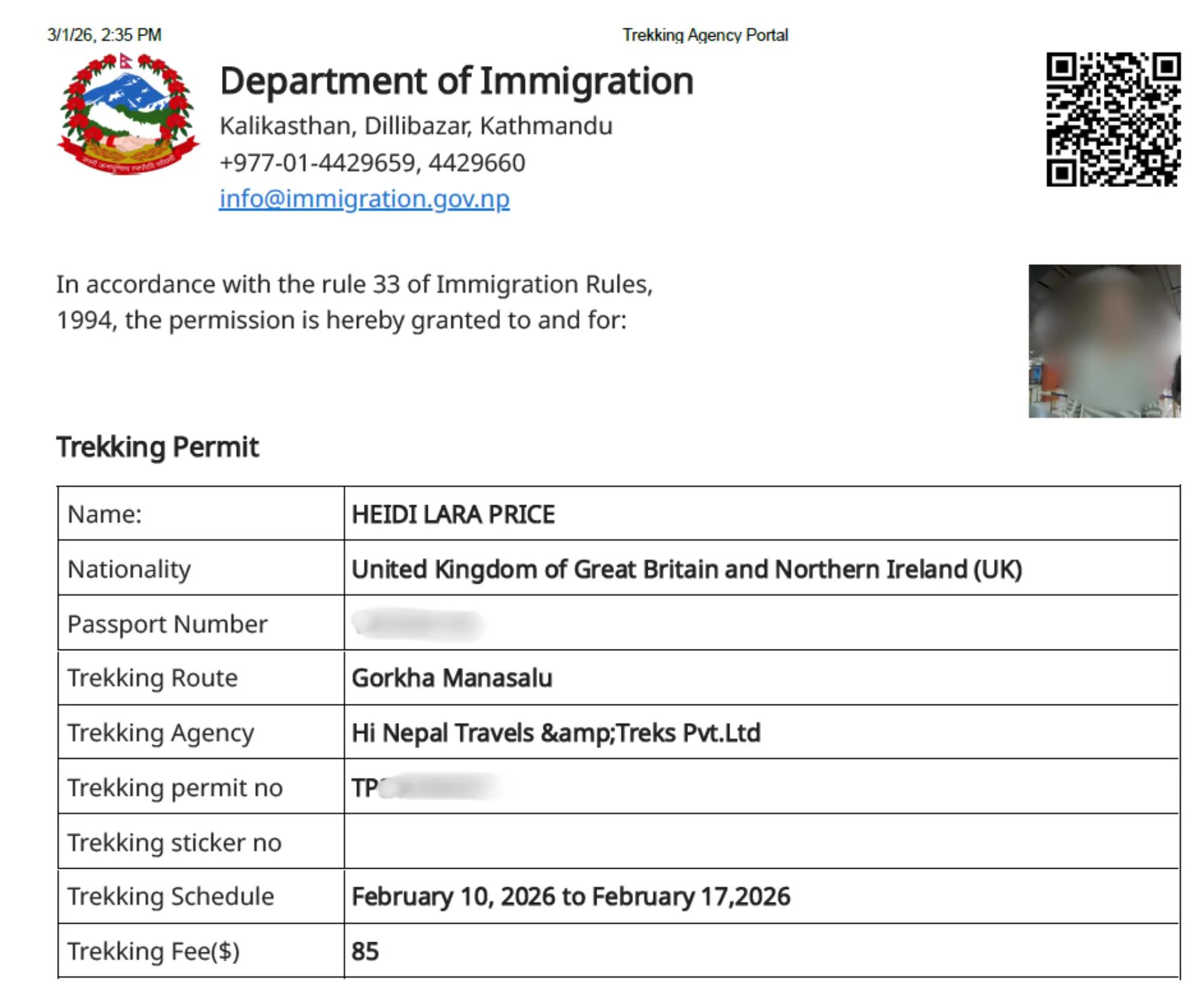
If you are planning the Manaslu Circuit Trek, permits are one of the first costs you need to understand.
The confusing part is that there is no single “Manaslu permit.” A standard Manaslu Circuit itinerary involves a Restricted Area Permit (RAP), Manaslu Conservation Area Permit (MCAP), Annapurna Conservation Area Permit (ACAP), and TIMS Card. A separate local fee may also apply in Chumnubri Rural Municipality.
The largest cost is the Manaslu Restricted Area Permit, because its price depends on the season and the number of days you spend inside the restricted area.
For foreign trekkers, the current RAP rate is:
- September–November: USD 100 for the first 7 days + USD 15 for each additional day
- December–August: USD 75 for the first 7 days + USD 10 for each additional day
The Department of Immigration currently lists these rates for the Gorkha Manaslu restricted area.
There was also an important rule change in March 2026: a foreign trekker can now apply individually for a Manaslu Restricted Area Permit through a registered trekking agency.
However, this does not mean you can trek the Manaslu restricted area without a guide. A licensed guide remains mandatory, and the revised policy allows one guide to lead a maximum of seven trekkers.
Manaslu Circuit Trek Permit Cost 2026 at a Glance
| Permit / Fee | Foreigners | SAARC Nationals | How it is charged |
|---|---|---|---|
| Manaslu Restricted Area Permit | USD 100 first 7 days + USD 15/day after | Same RAP rate | Seasonal |
| Manaslu Restricted Area Permit, Dec–Aug | USD 75 first 7 days + USD 10/day after | Same RAP rate | Seasonal |
| MCAP | NPR 3,000 | NPR 1,000 | Fixed |
| ACAP | NPR 3,000 | NPR 1,000 | Fixed |
| TIMS Card | NPR 2,000 | NPR 1,000 | Per trekker |
| Chumnubri local fee | Check current local rate | Check current local rate | May apply separately |
The Nepal Tourism Board currently lists NPR 3,000 for foreign visitors and NPR 1,000 for SAARC nationals for both the Manaslu and Annapurna Conservation Area permits. Its current TIMS provision lists NPR 2,000 for non-SAARC trekkers and NPR 1,000 for SAARC trekkers.
Because the RAP is calculated according to the number of days inside the restricted area, there is no single permit total that applies to every Manaslu itinerary.
What Permits Do You Need for the Manaslu Circuit Trek?
For a standard Manaslu Circuit route, you should budget for these permits and fees.
1. Manaslu Restricted Area Permit (RAP)
This is the main Manaslu special permit.
The Manaslu Circuit passes through Chumnubri Rural Municipality, which the Government of Nepal designates as a restricted trekking area. The RAP is therefore required for the applicable section of the route.
The current government rate is:
September–November
- USD 100 for the first 7 days
- USD 15 for every additional day
December–August
- USD 75 for the first 7 days
- USD 10 for every additional day
The fee is based on the number of days covered by your restricted-area permit, not simply the total number of days of your entire trek.
2. Manaslu Conservation Area Permit (MCAP)
The entire Manaslu Circuit passes through the Manaslu Conservation Area, so trekkers need an MCAP.
The current fee listed by Nepal Tourism Board is:
- Foreigners: NPR 3,000
- SAARC nationals: NPR 1,000
- Nepali citizens: NPR 100
The foreigner and SAARC rates are fixed rather than calculated according to the number of trekking days.
3. Annapurna Conservation Area Permit (ACAP)
ACAP is easy to overlook because the trek is called the Manaslu Circuit, not the Annapurna Circuit.
However, the standard route continues toward Dharapani, which lies within the Annapurna Conservation Area. That is why you need an ACAP as part of the usual Manaslu Circuit permit package.
The current NTB rate is:
- Foreigners: NPR 3,000
- SAARC nationals: NPR 1,000
- Nepali citizens: NPR 100
4. TIMS Card
The current Nepal Tourism Board TIMS provision lists the Manaslu Circuit Trek among the routes where a licensed guide and TIMS Card are mandatory.
The current TIMS charge is:
- Other foreign trekkers: NPR 2,000
- SAARC trekkers: NPR 1,000
TIMS is therefore something you should include in your Manaslu permit budget.
This is an important correction to older Manaslu permit guides that say TIMS is not required.
How Much Is the Manaslu Restricted Area Permit?
The Manaslu Restricted Area Permit cost depends on two things:
- Your trekking season
- How many days your permit covers inside the restricted area
September to November
The autumn rate is:
USD 100 for the first 7 days + USD 15 for each additional day.
For example:
| Restricted-area days | RAP cost |
|---|---|
| 7 days | USD 100 |
| 8 days | USD 115 |
| 9 days | USD 130 |
| 10 days | USD 145 |
| 11 days | USD 160 |
| 12 days | USD 175 |
| 14 days | USD 205 |
December to August
The lower-season rate is:
USD 75 for the first 7 days + USD 10 for each additional day.
| Restricted-area days | RAP cost |
|---|---|
| 7 days | USD 75 |
| 8 days | USD 85 |
| 9 days | USD 95 |
| 10 days | USD 105 |
| 11 days | USD 115 |
| 12 days | USD 125 |
| 14 days | USD 145 |
These are the current Department of Immigration rates for the Gorkha Manaslu restricted area.
Manaslu Circuit Permit Cost Example

It is better to calculate your permit budget based on the actual number of days covered by the RAP rather than saying that every 14-day Manaslu trek costs the same.
For example, suppose your itinerary requires 10 days of RAP coverage during October.
Your government permit costs would include:
- RAP: USD 145
- MCAP: NPR 3,000
- ACAP: NPR 3,000
- TIMS: NPR 2,000
- Any applicable local Chumnubri fee
The final USD equivalent will depend on the exchange rate and whether a local fee applies.
This is why quoting a single figure such as “Manaslu permits cost USD 210” can be misleading. The RAP alone changes according to the number of restricted-area days.
Does the Manaslu Circuit Require a TIMS Card?
Yes.
The current Nepal Tourism Board TIMS information specifically includes the Manaslu Circuit Trek under the routes requiring a licensed trekking guide and TIMS Card. The listed TIMS fee is NPR 2,000 for most foreign trekkers and NPR 1,000 for SAARC nationals.
If you are comparing Manaslu permit information from older articles, check the publication date carefully. TIMS requirements have changed over time, which is one reason older permit guides can give conflicting answers.
What Changed for Solo Trekkers in March 2026?
This is the biggest recent change to the Manaslu trekking permit system.
Before March 2026, foreign trekkers generally needed at least two people for a Restricted Area Permit application.
On March 22, 2026, the Department of Immigration revised its restricted-area trekking rules and removed that minimum for individual foreign tourists.
That means a person traveling alone can now obtain the Manaslu RAP through a registered trekking agency.
However, three important conditions remain:
- You still need a licensed trekking guide.
- The trek must be arranged through a registered trekking agency.
- One guide can lead a maximum of seven trekkers under the revised rule.
The change therefore allows solo permit applications, not unguided solo trekking.
So if you are searching for “Manaslu Circuit Trek solo permit”, the practical answer in 2026 is:
You can travel as an individual trekker, but you still need a licensed guide and registered agency.
Can You Get the Manaslu Permit Yourself?
No.
The Restricted Area Permit is not something an independent foreign trekker can simply purchase at a trailhead.
The Department of Immigration states that restricted-area trekking permits are issued through registered trekking agencies.
Your agency normally handles the permit application and coordinates the required documents before you begin the trek.
For the Manaslu Circuit, this is also useful because you need to coordinate several documents rather than only one permit.
What Documents Are Needed for the Manaslu Trek Permit?
Your trekking agency will normally need information such as:
- Passport details
- Passport copy
- Trekking dates
- Planned itinerary
- Passport photographs or digital photo
- Nepal visa information where applicable
- Travel insurance information
- Other documents required by the current permit application system
The exact documentation and submission procedure can change, so your agency should confirm what is required for your departure rather than relying on an old checklist.
The Department of Immigration has also moved restricted-area permit services toward digital processing. The March 2026 rule change allows foreign applicants outside Nepal to use an Application Submission ID when applying through the agency.
Where Is the Manaslu Restricted Area?
The Manaslu restricted area covered by the RAP is within Chumnubri Rural Municipality, Gorkha, specifically wards 1–4 according to the current government permit information.
This matters because the RAP does not simply mean “a permit for the whole Manaslu trek.” It applies to the designated restricted area and is charged according to the permitted duration there.
The trek also enters the Manaslu Conservation Area and later connects with the Annapurna Conservation Area, which is why several different permits are involved.
Why Does Manaslu Need a Restricted Area Permit?
Manaslu lies close to Nepal’s northern border and includes remote settlements with strong Tibetan cultural influence.
The restricted-area system gives the government greater control over access, trekking activity, and movement in sensitive border regions.
It also means that the Manaslu Circuit is regulated differently from a standard trekking route.
For trekkers, the practical result is simple:
You cannot treat Manaslu like an unrestricted independent trekking route.
You need the appropriate permit, a registered agency, and a licensed guide.
Is a Separate Permit Needed for Tsum Valley?
Yes.
If your itinerary includes Tsum Valley, you need the separate Tsum Valley Restricted Area Permit in addition to the permits required for the Manaslu Circuit.
The current Department of Immigration rate for Tsum Valley is:
- September–November: USD 40 per person for the first week + USD 7/day afterward
- December–August: USD 30 per person for the first week + USD 7/day afterward
So a Manaslu Circuit with Tsum Valley should not be priced using the Manaslu RAP alone.
If you are considering adding Tsum Valley, compare the extra permit cost with the additional trekking days and route changes before finalizing your itinerary.
What Is the Chumnubri Rural Municipality Fee?
There may also be a separate local fee charged by Chumnubri Rural Municipality.
The municipality announced a trekking fee of NPR 1,000 for foreign tourists and NPR 200 for domestic travelers in 2024, with collection planned at the Jagat checkpoint.
Because this is a local charge rather than one of the national permit fees, confirm the current amount and collection procedure before departure.
For that reason, we recommend showing it separately in your cost breakdown rather than presenting it as part of the government RAP, MCAP, or ACAP.
Manaslu Permit Cost for Indian and Other SAARC Trekkers
SAARC nationals receive lower rates for the conservation-area permits and TIMS.
For example:
| Fee | Foreign visitor | SAARC national |
|---|---|---|
| MCAP | NPR 3,000 | NPR 1,000 |
| ACAP | NPR 3,000 | NPR 1,000 |
| TIMS | NPR 2,000 | NPR 1,000 |
| Manaslu RAP | Seasonal foreign rate | Current RAP schedule applies |
The important point for Indian trekkers is that MCAP, ACAP, and TIMS are not charged at the standard foreign rate.
If you are planning the trek from India, tell your agency your nationality when requesting a quotation so the correct permit rates are used.
Manaslu Permit Cost vs Annapurna Circuit
The permit structure is one of the clearest differences between the Manaslu and Annapurna Circuit treks.
Manaslu requires a restricted-area permit in addition to conservation and trekking-management fees, while the Annapurna Circuit does not use the same Manaslu RAP system.
This is one reason the permit portion of a Manaslu trek is higher.
If you are comparing Manaslu Circuit vs Annapurna Circuit, do not compare only the advertised trekking package price. Look at what each package includes, particularly permits, guide services, accommodation, transport, and meals.
Do Permit Fees Change by Season?
Yes, but only the Manaslu Restricted Area Permit changes according to the current seasonal schedule.
| Season | First 7 days | Additional day |
|---|---|---|
| September–November | USD 100 | USD 15/day |
| December–August | USD 75 | USD 10/day |
MCAP, ACAP, and TIMS are not calculated using the Manaslu RAP’s seasonal daily structure.
This is why the same Manaslu itinerary can have a different permit cost depending on when you travel.
Do You Need a Permit for Larkya La Pass?
You do not purchase a separate Larkya La permit.
Larkya La is part of the Manaslu Circuit route, and the permits you already obtain for the trek cover the applicable trekking areas.
However, your guide and agency need to ensure your permit dates and itinerary cover the route you are actually taking.
For more information about the crossing itself, see our guide to Larkya La Pass.
How Hi Nepal Handles Manaslu Trek Permits
The easiest way to deal with Manaslu permits is to have the agency arranging your trek handle the paperwork as part of the booking.
At Hi Nepal Travels & Treks, we coordinate the required permit applications, confirm the current government fees, prepare the documentation, and arrange the licensed guide required for the Manaslu Circuit.
More importantly, we separate the permit costs from the rest of your trek cost so you can see what you are actually paying for.
If you are traveling solo, we can also arrange a private Manaslu trek under the current 2026 rules. You no longer need to find another foreign trekker simply to satisfy the former two-person RAP requirement, but a licensed guide remains mandatory.
For a complete breakdown of accommodation, transportation, meals, guide services, and other expenses, see our Manaslu Circuit Trek Cost guide before booking.
Manaslu Circuit Trek Permit FAQs
How much does the Manaslu Circuit Trek permit cost in 2026?
There is no single fixed total. The RAP costs USD 100 for the first seven days plus USD 15 per additional day from September to November, or USD 75 for the first seven days plus USD 10 per additional day from December to August. MCAP, ACAP, and TIMS are additional costs.
What is the Manaslu Restricted Area Permit cost?
The current RAP costs USD 100 for the first seven days plus USD 15 per additional day from September to November, and USD 75 for the first seven days plus USD 10 per additional day from December to August.
How much is the MCAP permit for Manaslu?
The current Manaslu Conservation Area Permit costs NPR 3,000 for foreign visitors and NPR 1,000 for SAARC nationals.
How much is the ACAP permit for the Manaslu Circuit?
The current ACAP fee is NPR 3,000 for foreign visitors and NPR 1,000 for SAARC nationals.
Is TIMS required for the Manaslu Circuit Trek?
Yes. The current Nepal Tourism Board TIMS provision lists the Manaslu Circuit Trek among the routes requiring a TIMS Card and licensed trekking guide. The listed fee is NPR 2,000 for most foreign trekkers and NPR 1,000 for SAARC trekkers.
Can I trek Manaslu alone in 2026?
You can now apply for the Manaslu Restricted Area Permit as an individual foreign trekker following the March 2026 rule change. However, you still need a licensed guide and must arrange the trek through a registered trekking agency.
Can I trek Manaslu without a guide?
No. The March 2026 change removed the former minimum number of trekkers for the permit application, but it did not remove the licensed-guide requirement.
How many trekkers can one guide take on Manaslu?
Under the March 2026 revised restricted-area rules, one licensed guide can lead a maximum of seven trekkers.
Do I need a separate permit for Tsum Valley?
Yes. Tsum Valley has its own Restricted Area Permit and fee structure. It is additional to the permits required for the Manaslu Circuit.
Are Manaslu permit fees refundable?
Government permit fees should be treated as non-refundable once the relevant permit has been issued. Confirm the cancellation and refund terms with your trekking agency before payment.
Can I apply for the Manaslu permit before arriving in Nepal?
The March 2026 changes introduced digital processing for restricted-area permits. Foreign applicants applying from abroad can use an Application Submission ID through their registered trekking agency.
How long is the Manaslu Restricted Area Permit valid?
The RAP is issued according to the dates and duration of your restricted-area itinerary. If you need additional days, the extension and additional daily fee need to be handled through the appropriate process.
Is the Manaslu permit more expensive than the Annapurna permit?
Generally, yes. The Manaslu Circuit has the additional seasonal Restricted Area Permit, while the Annapurna Circuit does not require the same Manaslu RAP. Your total trek budget should also account for MCAP/ACAP, TIMS, transport, accommodation, guide, and other services.